
Product Introduction
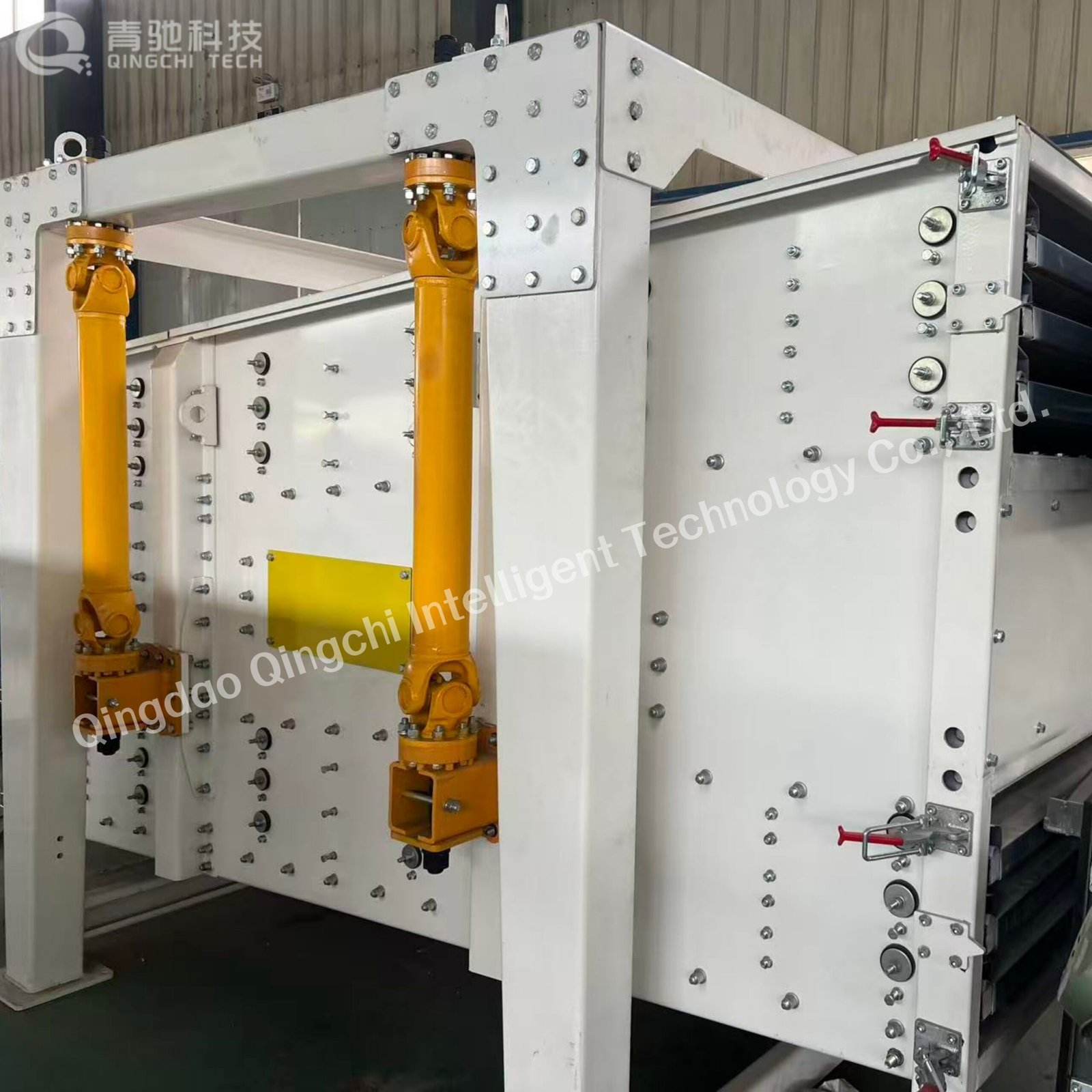
This SZF linear vibrating screen is core grading and impurity removal equipment specially designed for dry mortar production lines. Driven by dual vibration motors, it generates excitation force to make materials jump and move linearly on the screen deck. It is widely used for grading dried manufactured sand and quartz sand, removing oversized particles, stones, fibers and agglomerated impurities.
Stable sand gradation is critical for mortar quality. This vibrating screen effectively prevents coarse particles from entering finished mortar, guarantees workability, strength and consistency of plastering mortar, tile adhesive, putty, self-leveling mortar and other dry-mix products. It can run independently or be seamlessly integrated into automatic dry mortar production lines.
Key Advantages
✅ Optimized for dry mortar gradation Specially tuned deck angle and vibration parameters to reduce mesh blinding and material caking. High grading accuracy to stabilize sand particle distribution for various mortar formulas.
✅ Fully enclosed dustproof structure, eco-friendly Closed housing with reserved dust extraction ports to connect with central dust collection system. Minimizes powder leakage and dust emission to meet environmental standards.
✅ Adjustable excitation force & stable vibration system Dual vibration motor drive; excitation force and amplitude can be adjusted via eccentric blocks. The screen deck inclination is adjustable for quick switching between coarse, medium and fine sand screening.
✅ Modular design for easy maintenance Quick-release screen clamping structure for fast mesh replacement. Spring damping support lowers noise and reduces impact on factory foundation. Standardized wear parts for easy spare part supply.
✅ Multiple sizes & custom options 1–4 screen decks available for multi-stage classification. Mesh material: carbon steel or 304 stainless steel. Inlet/outlet direction and height can be customized for new plants or old-line retrofitting.
✅ High-strength screen box, anti-fatigue Optimized welded screen frame to resist cracking under long-time continuous heavy load, suitable for 24-hour non-stop operation in mortar factories.
Specification Table
| Item | SZF1020 | SZF1225 | SZF1536 | SZF1840 |
|---|---|---|---|---|
| Screen size | 1000×2000mm | 1200×2500mm | 1500×3600mm | 1800×4000mm |
| Number of decks | 1–2 layers | 1–3 layers | 1–3 layers | 1–4 layers |
| Capacity (dry sand) | 10~40 t/h | 30~70 t/h | 50~120 t/h | 80~200 t/h |
| Screening range | 0.075~5 mm | 0.075~5 mm | 0.075~5 mm | 0.075~5 mm |
| Vibration motor power | 1.1kW×2 | 2.2kW×2 | 3.7kW×2 | 5.5kW×2 |
| Screen inclination | 0~15° adjustable | 0~15° adjustable | 0~15° adjustable | 0~15° adjustable |
| Mesh material | Carbon steel / 304 stainless steel | Carbon steel / 304 stainless steel | Carbon steel / 304 stainless steel | Carbon steel / 304 stainless steel |
| Approx. weight | 1.8 t | 2.8 t | 4.5 t | 7.2 t |
| Power supply | 380V, 50Hz | 380V, 50Hz | 380V, 50Hz | 380V, 50Hz |
Operating Notes
- Pre-start inspection: Check all bolts and damping springs for looseness or breakage. Ensure mesh is evenly tensioned and intact. Clear debris on screen surface and confirm dust pipeline connection.
- Startup sequence: Start the vibrating screen under no load. After stable operation, start upstream feeding equipment. Stop feeding first, wait until all material is discharged before shutting down. Do not start or stop with loaded screen.
- Material control: Suitable only for loose dry sand. Recommended moisture ≤3%. Prevent large metal or hard objects from hitting the mesh.
- Excitation force setting: Eccentric blocks of two vibration motors must be set at the same angle. Uneven setting will cause swing and resonance. Do not reverse rotation direction of the two motors.
- Daily maintenance: Clean blocked mesh every shift. Lubricate motor bearings periodically. Check fasteners, springs and mesh wear weekly. Stop immediately for abnormal noise or vibration.
- Safety rules: Do not open access panels during operation. Cut off power and lockout-tagout before maintenance. Reliable earthing required. Never remove safety guards.
- Environment: Avoid long-term outdoor exposure to rain to prevent motor dampness and frame rust.
Application Scenarios
- Dry-mix mortar production lines: sand grading and impurity removal for plastering mortar, masonry mortar, tile adhesive, grout, exterior putty, self-leveling mortar.
- Dried sand & manufactured sand plant: classify quartz sand and limestone sand after drying, remove mud lumps, plant roots and metal debris.
- Gypsum-based mortar & thermal insulation mortar lines: screening lightweight aggregates and vitrified microspheres.
- Upgrade and renovation of existing mortar production lines: replace old screening machines to improve sand gradation stability.
- Sand and powder processing plants for building materials: grading dry aggregates.
FAQ
Q1: Why is the screen mesh easily blinded? How to solve it? A: Main causes: high sand moisture, too small mesh aperture, overfeeding or loose mesh. Solutions: reduce raw material moisture, select larger mesh, lower feeding rate, re-tension the screen and increase excitation force properly.
Q2: Vibration motors overheat and make loud noise? A: Check if motor rotation direction and eccentric block angles are synchronized. Aging springs or base interference will trigger resonance. Overheating may also be caused by insufficient lubrication or damaged bearings; refill grease or replace bearings.
Q3: Poor separation, mixed particle sizes after screening? A: Material biased feeding, broken mesh, improper deck angle or overloaded capacity. Adjust feeding guide, replace damaged mesh, tune inclination and reduce feed rate.
Q4: Can this machine screen wet sand? A: Not suitable for continuous wet sand screening. Moisture above 5% will cause severe blinding and low efficiency. Wet sand needs separate washing screening solution.
Q5: Can we get stainless steel version and customized voltage for export? A: 304 stainless steel mesh or full stainless steel machine is available. Custom voltage such as 415V / 440V is supported, with CE documents for export.
Q6: Does this vibrating screen require special concrete foundation? A: Heavy concrete foundation is generally not required. A flat and stable bearing platform is enough. Damping springs reduce load transfer, but the supporting structure must be rigid without shaking.