
Product Overview
Qingchi inclined turbulent 3D mixing granulator is an all-in-one high-efficiency granulating equipment integrating powder mixing, wet granulation and spheronization. Adopting an inclined cylinder structure, together with an eccentric high-speed granulating tool set and fixed scrapers on the cylinder side, it creates complex 3D turbulent material flow inside the chamber. It completes uniform mixing, binder dispersion, agglomeration and spheronization in a short time.
Compared with traditional horizontal or vertical wet granulators, Qingchi inclined mixing granulator features high spheronization rate, good particle roundness, uniform particle size, low material residue after discharge and easy cleaning & maintenance. It covers lab-scale testing, pilot scale-up and industrial mass production, widely used in new energy materials, refractory materials, ceramics, fine chemicals, building materials, feed & fertilizer and new material R&D.
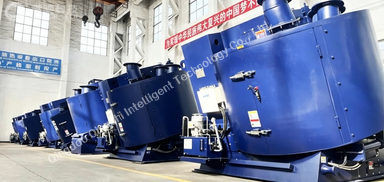
Granulation Principle
The core components include the inclined mixing granulation cylinder, high-speed granulating tool set and fixed side scrapers.
During operation, the inclined cylinder rotates clockwise at a low speed to continuously feed materials into the working zone of the high-speed granulating tool set. The eccentric high-speed rotor rotates at high speed in reverse or the same direction to generate strong shearing, dispersion and tumbling force. The fixed scrapers at the bottom side of the cylinder remove materials sticking to the wall, break local agglomerates and guide material flow toward the rotor.
Under the combined action of rotating cylinder, high-speed rotor and guiding scrapers, powder and binder are mixed evenly rapidly, then form spherical particles through continuous agglomeration, rolling and rounding. The rotating speed of cylinder and rotor can be adjusted independently, and online speed adjustment is available to realize staggered mixing & granulation, meeting diverse formulas and particle size requirements.
Core Advantages
- 3D turbulent granulation for superior spherical particles The inclined cylinder, high-speed rotor and fixed scrapers work synergistically to build a 3D turbulent field. Uniform mixing, high spheronization rate, good roundness, narrow particle size distribution and stable particle strength.
- Independent speed control for cylinder & rotor, strong process adaptability The cylinder and rotor adopt independent frequency conversion speed regulation. Parameters can be flexibly adjusted according to material properties, binder systems and target particle specifications, suitable for multi-variety and multi-formula development and production.
- Thorough discharge, low residue and easy cleaning Equipped with hydraulic tipping discharge or bottom discharge. Fast discharging with minimal material residue inside the cylinder, reducing raw material waste and simplifying batch/color change and equipment cleaning.
- Full product range for R&D and mass production The series includes lab-scale, pilot and industrial models, supporting formula sampling, process verification and large-scale continuous production.
- Fully enclosed operation, low dust and eco-friendly Mixing, granulation and spheronization are finished in a sealed chamber, effectively suppressing dust emission to meet clean and environmental-friendly production standards.
- Flexible configuration and custom design available Optional accessories: heating jacket, liquid cooling system, vacuum system, various rotors, wear/corrosion-resistant liners, spray liquid feeding system and explosion-proof components.
- Excellent temperature control for special processes The cylinder can be fitted with heating or cooling jackets with online temperature monitoring. Max processing temperature reaches 300℃, ideal for temperature-sensitive granulation processes.
- High automation control, stable operation Independent control cabinet, optional touch-screen PLC automatic control. Parameter setting, status monitoring and automatic operation are supported for stable repeatability.
Specification Parameters (Reference, Customizable)
| Item | Description |
|---|---|
| Cylinder Structure | Inclined mixing granulation cylinder, adjustable tilt angle |
| Cylinder Material | Standard stainless steel; custom corrosion & wear-resistant liners available |
| Driving Mode | Dual frequency conversion independent drive, separate speed control for cylinder and rotor |
| Rotor Types | Star rotor, tooth disc rotor, blade rotor, sickle rotor for selection |
| Scraper Options | Fixed side scrapers; optional lining: PTFE, polyamide, tungsten carbide, ceramic |
| Temperature Control | Max working temperature: 300℃; support jacket heating & liquid cooling |
| Liquid Feeding | Manual feeding or automatic spray binder feeding |
| Discharge Method | Hydraulic tipping discharge / bottom discharge |
| Control Mode | Button control / touch-screen PLC automatic control |
| Optional Accessories | Vacuum system, heating/cooling jacket, spray feeding, explosion-proof motor, wear-resistant liner |
| Particle Size Range | Adjustable according to formula, rotating speed, liquid dosage and process conditions |
Operation Notes
- Pre-start inspection Check fasteners of rotor, scrapers and cylinder; inspect liners and seals. Verify emergency stop, safety interlock and hydraulic system. Ensure no metal foreign objects inside the cylinder before feeding.
- Control feeding volume Do not overload the cylinder. Overfeeding will reduce granulation quality, cause motor overload and abnormal vibration.
- Uniform binder addition Add binder by continuous spraying for wet granulation. Avoid one-time large-volume liquid feeding, which causes local agglomeration and uneven particle size.
- Safety during operation Never open the safety guard or put hands/tools into the cylinder while running. Stop immediately, cut off power and troubleshoot in case of abnormal noise, heavy vibration, oil leakage or smoke.
- Cleaning & maintenance Clean the cylinder, rotor and scrapers promptly after each batch. Protect electric cabinet, motor and hydraulic station from water. Keep the inner chamber dry and anti-rust for long-term shutdown.
- Regular inspection of wearing parts For highly abrasive materials, regularly check the wear of rotor, scrapers and liners and replace worn parts timely to guarantee stable particle quality.
- Earthing & explosion-proof requirement The equipment must be reliably earthed. For flammable and explosive dust environments, explosion-proof motor and electric control system are mandatory. Standard models are not allowed for explosion-risk working conditions.
Application Scenarios
✅ Laboratory & R&D: New material formula test, small-batch sampling, process development
✅ New Energy Materials: Wet granulation for cathode, anode and related powder materials
✅ Refractory Industry: Refractory powder, castable and raw material granulation
✅ Ceramic Industry: Ceramic body powder, color powder and functional ceramic granulation
✅ Fine Chemicals: Catalysts, pigments, dyes and additives granulation
✅ Building Materials: Mineral powder, kaolin, bentonite and other powder granulation
✅ Feed & Fertilizer: Compound fertilizer, additives and premix wet granulation
✅ Other Powder Industries: Uniform mixing, wet agglomeration and spherical particle preparation
FAQ
Q1: What is the difference between Qingchi inclined mixing granulator and ordinary high-speed wet granulator?
A: Qingchi inclined mixing granulator adopts inclined cylinder, eccentric high-speed rotor and fixed scrapers for 3D turbulent mixing and spheronization. It achieves better spheronization rate, roundness and particle uniformity. Discharge is more thorough, which suits frequent batch/color change and multi-formula production.
Q2: Can particle size be adjusted?
A: Yes. Particle size and strength can be controlled by adjusting cylinder speed, rotor speed, granulation time, binder dosage, feeding rate and material moisture content.
Q3: Can this machine do dry powder mixing?
A: Yes. It can complete dry powder pre-mixing first, then add binder for wet granulation, integrating dry mixing, wet mixing, granulation and spheronization.
Q4: Are rotors and scrapers easy to wear out?
A: For highly abrasive materials, tungsten carbide or ceramic rotors and scrapers are recommended. Stainless steel is suitable for common powder. Wear condition should be checked periodically.
Q5: Can the machine support heating or vacuum granulation?
A: Yes. Heating jacket, liquid cooling system and vacuum system can be configured on demand for temperature control or negative-pressure granulation.
Q6: Are small lab models available?
A: Yes. Qingchi series includes lab-scale granulators for new material R&D and formula testing. The process parameters can be scaled up smoothly to pilot and industrial models.
Q7: Will there be much residual material after discharging?
A: Residue is low. With inclined cylinder plus tipping or bottom discharge, material flows out smoothly. It reduces raw material loss and cross-contamination between batches.